
Any long-term successful trader will know that insulating your portfolio with prudent forms of risk management and adequate hedging strategies is what separates the great from the good. Seasonally speaking, September is typically a weak month for stocks. In fact, it is on average, the weakest month of the year for US equities. During these periods of expected market turmoil, most will say ‘sell’ or ‘hold off’ to avoid running into any traps and losing their dough, however, personally speaking after trading markets professionally now for over 30 years – this is the completely wrong psychology.
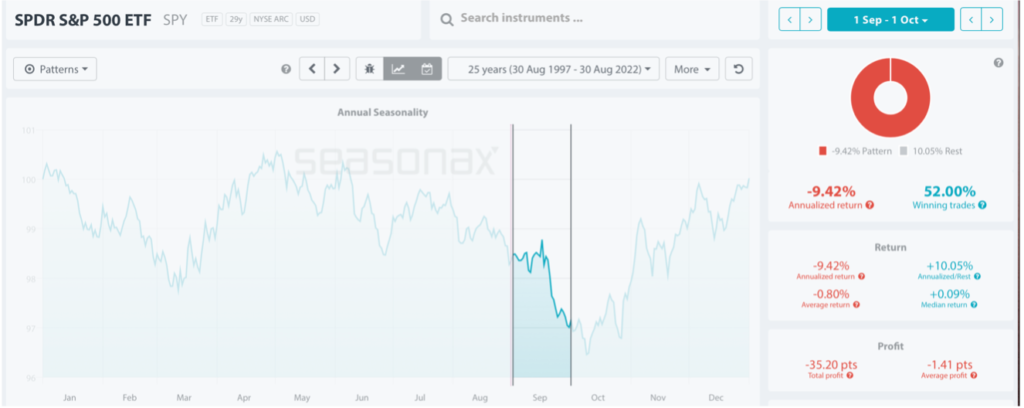
Now before we go through some ideas on how you could trade such market conditions (given they do actually occur, sometimes September is strong!) and what may be some risk management strategies around that, let’s actually look at some numbers here. Using our seasonal analysis scanning tool, here is the month of September for US equities. As you can see, the market over the last 25 years on average has lost around 0.8% and only trades higher just 52% of the time. Upon first glance this doesn’t look so bad, right? However, some of the biggest falls in history have occurred in the month of September for US equities. Here’s how it looks on the ASX:
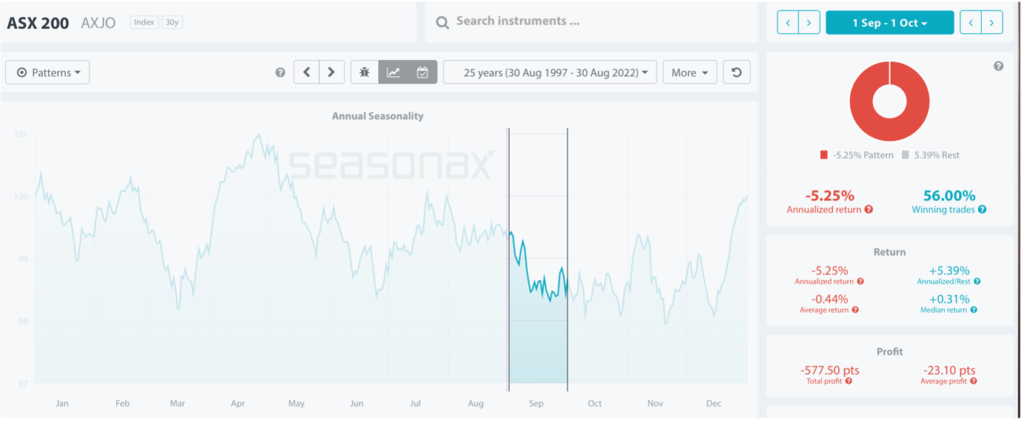
According to the figures, it’s only usually half as bad, indicating an average 0.44% decline in the market through September.
So, the question arises, how do you trade a market that usually goes down for the month? Well, my advice firstly wouldn’t be to bury your head in the sand and stop trading all together. People who do this often miss the big rallies and ‘get in’ way too late to the party. Maintaining a proper trading routine and carrying out your normal process works best, just as long as you have some protection in place. This would come in the form of either a) risk management via a stop loss or use of bought put options, or b) undertaking a hedge. A hedge is a way of protecting yourself against loss by setting up a trade that will profit if the market goes down. Yes, that’s right, you can do that!
Some of my favourite hedging techniques, in the lead-up to what is expected to be a choppy time for markets, includes buying some volatility like some options on the VIX, or buying some short ETF’s. Instruments like SH or PSQ allow for short US equity exposure or BEAR if you’re looking for something on the ASX. If markets do pull back in September as they are expected too seasonally, these instruments will profit – offering a great ability for you to hedge in your portfolio.
Let’s face it – the stock market rewards action takers. To those savvy investors out there the month of September can present some amazing opportunities if we do see the choppiness we can often get. However, playing things a little smarter this September by setting your portfolio which contains elements of both risk management and hedging instruments can help insulate your positions to protect your downside. For anyone unsure on how exactly to do this, reach out to my team at Australian Investment Education to learn more: http://bit.ly/aie-mjb
Frequently Asked Questions
1. Why is September considered a weak month for stocks?
September is often considered a weak month for equities due to historical seasonal trends where markets have shown lower average returns and higher volatility compared to other months.
2. How do US and ASX markets typically perform in September?
Historically, US equities tend to show slightly negative average returns in September, while the ASX also shows weaker-than-average performance, although outcomes vary year to year.
3. Does the stock market always fall in September?
No, the stock market does not always fall in September. While it has a seasonal tendency toward weakness, there are many years where markets still finish the month positive.
4. Why does market volatility increase in September?
Volatility can increase due to seasonal portfolio repositioning, institutional trading activity after summer, and uncertainty around macroeconomic data releases and central bank expectations.
5. What is risk management in trading?
Risk management refers to strategies used to limit potential losses in trading or investing. This includes position sizing, stop-loss orders, diversification, and hedging strategies to protect capital during market downturns.
6. What is hedging in the stock market?
Hedging is a strategy used to reduce risk by taking positions that may profit if the main investment moves against you. It is commonly used to protect portfolios during periods of expected volatility.
7. What are common hedging strategies for stock market investors?
Common hedging strategies include buying put options, using volatility instruments, or shorting index ETFs. These tools can help offset losses during market downturns or volatile periods like September.
8. Can learning trading and hedging strategies improve portfolio performance?
Yes. Understanding stock market risk management techniques can help investors protect capital and make more informed decisions during volatile market conditions. Structured investing education can help traders apply these strategies more effectively in real markets.
If you want to learn how professional traders manage risk and build hedged portfolios, you can explore structured programs at Australian Investment Education, which focuses on trading strategy, risk management, and market behavior frameworks.